
Turner County Court Records After Arrest
A Turner County arrest creates more than one paper trail. The jail record starts with booking at Turner County Jail and may show custody status, arrest charge, bond, court, and release information. The court record starts when the charge is filed, scheduled, heard, amended, dismissed, or resolved. That difference matters because a booking charge is not the same as a filed accusation, indictment, plea, verdict, or conviction.
Turner County court records after a jail arrest can involve Magistrate Court for warrants and first-appearance matters, State Court for misdemeanor or traffic-related criminal matters, Superior Court for felony and other higher criminal matters, and the Tifton Judicial Circuit District Attorney for prosecution decisions. For the custody side, use Turner County jail inmate records. For booking photos, use the separate Turner County jail mugshots page because Georgia booking-photo law has its own rules.
Search Turner County Court Records
Georgia Courts lists Turner State and Turner Superior as e-access courts through PeachCourt. The state e-access page says users are redirected to the provider's website and must have an account to search court records. PeachCourt describes its platform as covering civil and criminal eFiling and court documents across Georgia. That makes PeachCourt a key online path, but not the only path, for court records after a jail arrest in Turner County.
Georgia Courts e-access lists Turner State and Turner Superior court access through the statewide court-records provider structure.
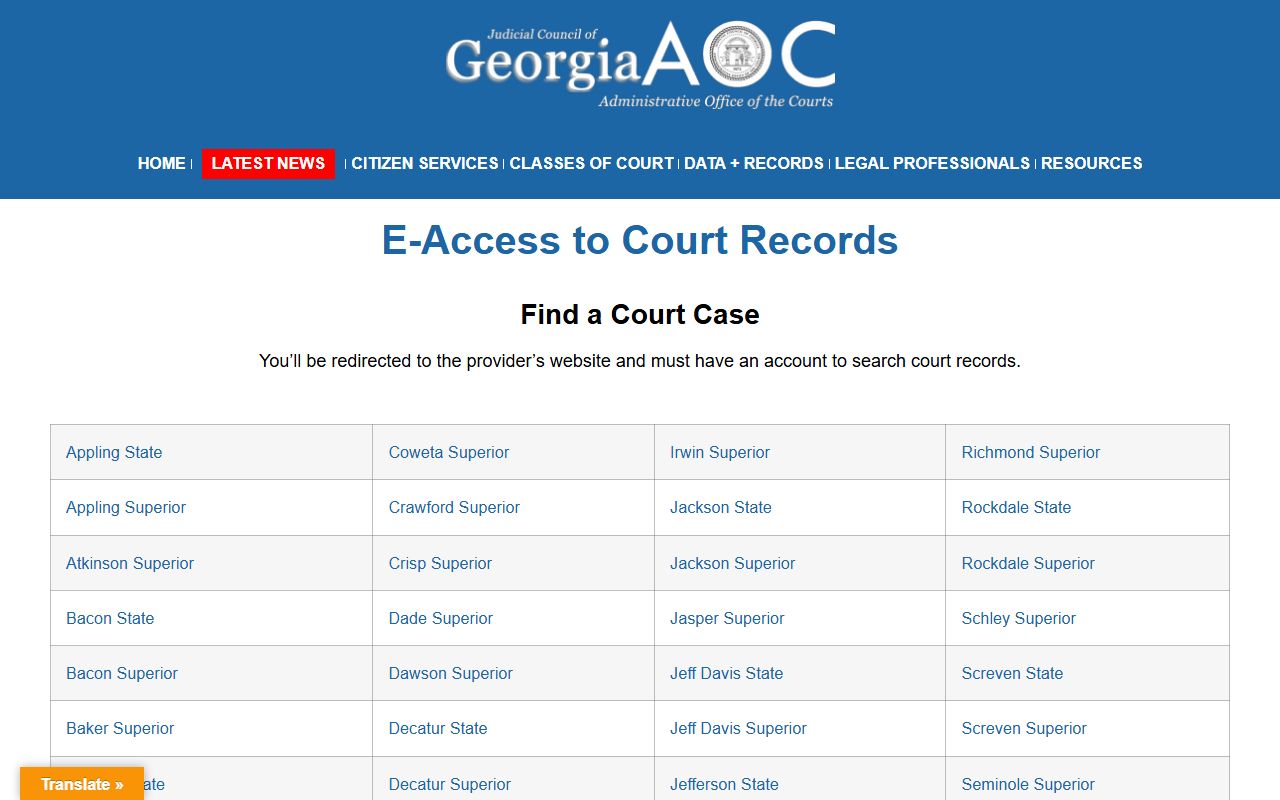
The e-access list points users toward account-based court document access rather than the sheriff's jail roster.
- Start with the jail roster if the arrest date, booking charge, or custody status is unknown.
- Search PeachCourt or Georgia e-access for Turner State or Turner Superior if the case has been filed.
- Contact the Clerk of Superior Court for felony, juvenile, warrant, arraignment, and older file questions.
- Contact Magistrate Court for first appearance, lower-court warrants, and preliminary matters.
- Call the Tifton Judicial Circuit District Attorney for prosecution status when the filed charge is unclear.
Turner County Court Access Channels
Online account access can be useful, but Turner County still has local court offices that hold or route criminal records. Mary L. Green is listed as Clerk of Court. The GSCCCA Turner County clerk listing gives Turner County Court at 219 E. College Ave., Room 3, P.O. Box 106, Ashburn, GA 31714, phone 229-567-2011, and fax 229-567-0450. The county contact page lists Magistrate Court at 219 E College St with phone 229-567-3155.
| Channel | Use it for | Research detail |
|---|---|---|
| PeachCourt | Account-based case and document access | Georgia Courts says account required. |
| Clerk of Superior Court | Criminal records, warrants, bond forfeitures, arraignment notices | Phone 229-567-2011. |
| State Court | Criminal and civil judicial services within Turner County | County page confirms criminal jurisdiction language. |
| Magistrate Court | Warrants, first appearance, lower-level matters | Phone 229-567-3155. |
| Tifton Judicial Circuit | Circuit calendars and court context | Serves Irwin, Tift, Turner, and Worth Counties. |
Charging Documents After Arrest
After a Turner County jail arrest, the prosecutor may file or pursue charges that differ from the jail booking label. The District Attorney for the Tifton Judicial Circuit is Patrick Warren, and the sheriff FAQ says to call the District Attorney's Office at 229-386-7900 for criminal case status. Charges may be filed by accusation, indictment, complaint, or another court document depending on offense type and court stage.
| Document | Who uses it | What it means |
|---|---|---|
| Complaint | Officer, prosecutor, or court process | Begins or supports lower-level charging and warrant matters. |
| Information or accusation | Prosecutor | States the charge the prosecutor is pursuing without grand-jury indictment in the applicable process. |
| Indictment | Grand jury | Formal felony charging document after grand-jury action. |
Turner County Charge Status
Charge status is the part of court records after arrest that prevents many mistakes. A pending charge is still open. A dismissed charge is not a conviction. Nolle prosequi means the prosecutor chose not to prosecute that count. A bond forfeiture may appear when a person misses court after release. A bench warrant can follow a failure to appear or another court-order violation.
| Status | What It Means |
|---|---|
| Pending | The case or count has not reached final disposition. |
| Amended or reduced | The charge changed from the original booking or filed label. |
| Dismissed | The court or prosecutor ended that charge without a conviction on it. |
| Nolle prosequi | The prosecutor declined to proceed on that charge. |
| Convicted | A plea or verdict resulted in a conviction. |
Bond After Turner County Arrest
Bond information often sits at the border between jail records and court records. The sheriff FAQ lists three local release routes: cash bond, property bond, and bonding company. Cash bond uses U.S. currency or money orders only. Property bond uses real property located in Georgia, and the FAQ says the person posting one needs the deed or a tax statement showing taxes are paid. Bonding-company information is available from the County Sheriff's Office Jail at 229-567-3812.
The sheriff's online services link nCourt 24-hour cash bond payments. Verify the person, case, bond eligibility, and any holds before paying. Georgia bond statutes in the research include O.C.G.A. 17-6-1 for bailable offenses and bond procedure, O.C.G.A. 17-6-2 for misdemeanor bail acceptance, and O.C.G.A. 17-6-12 for unsecured judicial release.
| Bond Type | How It Works |
|---|---|
| Cash bond | Paid in U.S. currency or money orders under the sheriff FAQ. |
| Property bond | Uses Georgia real property with deed or paid-tax proof. |
| Bonding company | Private bondsman route; fees are set by the company. |
| Unsecured judicial release | Georgia law allows it in some cases, but some defendants require secured means. |
| No-bond or hold | A warrant, detainer, probation, ICE, federal, or other hold may block release. |
Warrants Before Court Records
No official Turner County online active-warrant search was located. The Clerk of Superior Court page lists warrants, bench warrants, and bond forfeitures among filed records. Magistrate Court is the local contact for lower-court warrant matters. The sheriff can also be called or visited for jail or warrant-related routing, but an open warrant can lead to arrest, so people should not assume a public web search is the full answer.
- Arrest warrant
- A court order authorizing arrest.
- Bench warrant
- A court warrant, often after failure to appear.
- Detainer
- A hold request from another agency or jurisdiction.
- Bond forfeiture
- A court action tied to failure to meet bond or appearance terms.
Charges vs Convictions
Turner County court records after arrest must be read by stage. An arrest means law enforcement took a person into custody. A charge means an accusation is being made. A conviction means a court outcome, plea, or verdict established guilt on a charge. Using a booking charge as though it were a conviction is a serious error.
| Charge | Conviction | |
|---|---|---|
| Stage | Accusation or filed count | Final court outcome on that count |
| Can change? | Yes, it may be amended, reduced, added, or dropped | Changes only through court processes such as appeal or post-judgment relief |
| Where seen | Jail roster, complaint, accusation, indictment, docket | Disposition, sentence, plea, judgment, or order |
Sealed and Restricted Records
Georgia uses record restriction language rather than the everyday term expungement in many contexts. O.C.G.A. 35-3-37 controls eligible record restriction. Court and criminal-history records may also be unavailable to the public for reasons unrelated to record restriction. Turner County Clerk information says records not available to the general public include juvenile, adoption, and military discharge records.
| Restricted or sealed | Expunged in common speech | |
|---|---|---|
| Public visibility | Access is limited or hidden from routine public view. | Often used by the public to mean removed from normal access. |
| Georgia route | O.C.G.A. 35-3-37 record restriction. | Confirm eligibility through the court or an attorney. |
| Still possible access | Some justice agencies may retain access. | Depends on the order and record type. |
Restricted Turner Court Records
Not every record tied to an arrest is public at every moment. Georgia open-records exemptions may apply to pending law-enforcement and prosecution records, although initial arrest and incident reports have their own access rules. Juvenile records, adoption records, and military discharge records are identified by the Turner County Clerk page as not available to the general public. Court accounts, document fees, sealed records, and active-case limits can also affect what a reader can see online.
Important: Do not use casual court or jail lookup results for employment, tenant, credit, insurance, or other FCRA-covered screening decisions.